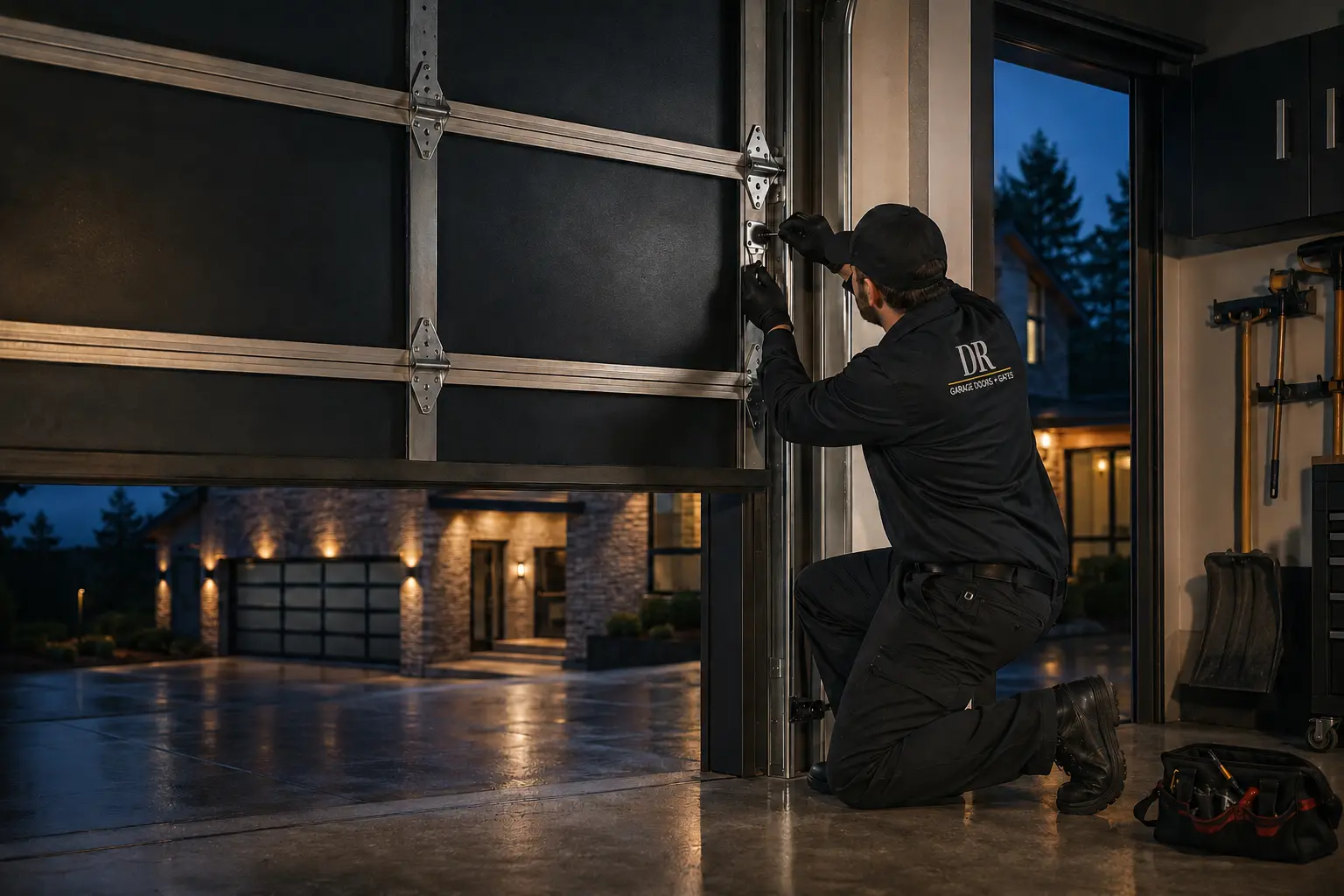
A door that will not open does not automatically mean the opener failed. The safest diagnosis starts with the door's position, balance, lifting hardware and visible travel path.
Start with what happens when you press the button
Listen and watch without repeatedly cycling the system. No sound at all can point toward power, the wall control, lock mode or the opener's electronics. A click or hum with no door movement can involve the opener drive, but it can also be the opener straining against a door that is too heavy or mechanically blocked.
If the motor runs and the trolley moves but the door stays down, stop. The door may be disconnected, the lifting system may have failed, or the connection between the trolley and door may be damaged. Repeated attempts can add opener damage to the original fault.
Look for a spring or cable problem
With the door closed, a visible gap in a torsion spring above the opening is a strong sign that the counterbalance system has failed. On extension-spring systems, a stretched, separated or hanging spring beside the horizontal track needs the same caution.
A loose cable, cable hanging beside the track or a door that begins lifting one corner first points toward uneven tension. Do not remove bottom brackets or touch cable drums: those components can still be carrying spring force.
Rule out simple controls without bypassing safety
Confirm that the opener has power, the wall station is not in lock mode and the door's manual lock has not been engaged. Test the wall control separately from the remote. If only the remote fails, the battery, programming, interference or receiver may be involved.
Do not defeat the photo eyes or increase opener force to push through resistance. A properly working opener is intended to move a balanced door, not overcome a broken spring, seized roller or obstructed track.
When to stop immediately
Stop if the door is crooked, unsupported, off its track, unusually heavy, or held open with a loose cable. Keep people and vehicles away from the opening and describe the exact position when requesting repair. A full-door photo plus close photos of the spring, cables and opener usually provide a better starting point than a guess about which part failed.